For years, college degrees were seen as the primary signal of readiness for the workforce.
And while degrees still matter, the hiring landscape is changing.
Employers today are asking a different question:
“What can you actually do?”
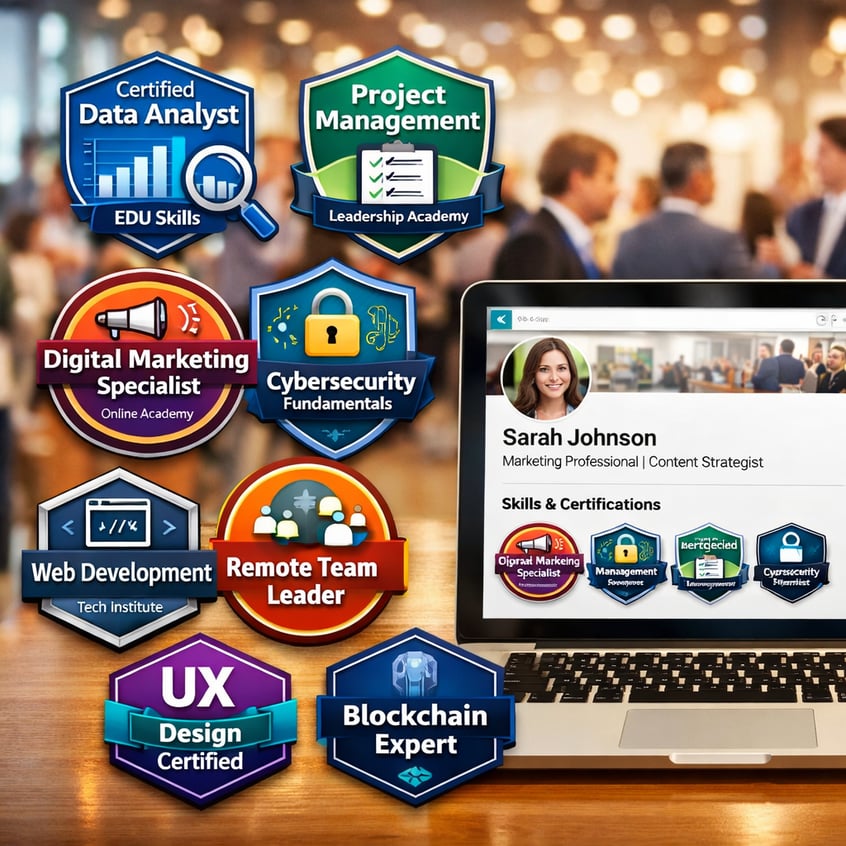
That shift has led to the rise of digital badges and micro-credentials—verified, skill-based credentials that showcase specific competencies in a way that traditional resumes often can’t.
If you’re a student or recent graduate, understanding how to earn, display, and leverage these credentials can give you a real advantage.
Because in today’s job market, it’s not just about what you studied—
It’s about what you can prove.
What Are Digital Badges?
A digital badge is a verified, shareable credential that represents a specific skill, achievement, or competency.
Unlike a line on a resume, digital badges are:
- Clickable
- Verified
- Backed by evidence
Each badge typically includes:
- The issuing organization
- The skills demonstrated
- The criteria required to earn it
- Proof of completion or assessment
This makes credential verification easy for employers.
Instead of taking your word for it, they can see exactly what you’ve done.
Why Employers Are Paying Attention
The workplace is evolving faster than traditional education systems can keep up.
New tools, technologies, and skills emerge constantly.
Employers need a way to evaluate candidates based on current, relevant abilities.
That’s where digital certification and micro-credentials come in.
1. Skills Over Titles
A degree tells employers what you studied.
A badge tells them what you can do.
For example:
- A marketing degree is broad
- A digital badge in SEO analytics is specific
Specific skills are easier to evaluate—and apply directly to roles.
2. Faster Skill Validation
Hiring managers don’t have time to guess whether a candidate has the skills they claim.
Digital badges provide quick, verifiable proof.
This reduces uncertainty in hiring decisions.
3. Continuous Learning Signals
Earning badges shows initiative.
It tells employers:
- You’re proactive
- You’re committed to learning
- You stay current with industry trends
In a rapidly changing job market, that mindset matters.
4. Alignment With Industry Needs
Many badges are designed in collaboration with employers or industry experts.
This means they often reflect real-world skills—not just academic theory.
What Are Micro-Credentials?
Micro-credentials are short, focused learning experiences that result in a specific certification or badge.
Think of them as:
- Targeted
- Practical
- Skill-driven
Unlike traditional courses that cover broad topics, micro-credentials focus on one area.
Examples include:
- Data analysis basics
- Project management fundamentals
- Digital marketing strategies
- Leadership and communication skills
They are a core part of the growing micro credentials career landscape.
The Shift From Degrees to Skills
Let’s be clear:
Degrees still matter.
But they are no longer the only—or even the primary—way employers evaluate candidates.
The shift is happening because:
- Skills change faster than degree programs
- Employers need job-ready candidates
- Technology is reshaping every industry
Digital badges fill the gap between education and application.
How to Earn Digital Badges
Getting started with digital badges is more accessible than ever.
1. Online Learning Platforms
Many platforms offer courses that result in badges or certifications.
Look for programs that include:
- Assessments
- Projects
- Verified outcomes
2. Professional Organizations
Organizations like SCLA provide opportunities to earn badges tied to leadership, communication, and professional development.
These credentials often carry additional weight because they are aligned with real-world expectations.
3. Industry Certifications
Some companies offer their own certifications.
These can be especially valuable if they align with tools or systems used in your desired field.
4. Campus and Academic Programs
Some colleges are beginning to integrate badge systems into coursework or extracurricular activities.
This allows students to build credentials alongside their degree.
Building a Badge Portfolio
Earning badges is one thing.
Using them effectively is another.
A badge portfolio is a curated collection of your credentials that showcases your skills.
What to Include
- Relevant digital badges
- Certifications
- Projects or examples of your work
- Links to verified credentials
Where to Display It
- LinkedIn profile
- Personal website or portfolio
- Resume (with links)
- Email signature (select badges)
The goal is to make your skills visible and easy to verify.
How to Use Digital Badges in Your Job Search
Digital badges are most powerful when they are integrated into your overall career strategy.
1. Strengthen Your Resume
Instead of simply listing skills, you can support them with verified credentials.
Example:
Skills: Data Analysis
Credential: Google Data Analytics Badge (linked)
This adds credibility.
2. Enhance Your LinkedIn Profile
LinkedIn allows you to add certifications and credentials.
This increases your visibility in recruiter searches.
3. Talk About Them in Interviews
Don’t assume employers will notice your badges automatically.
Bring them up.
Example:
“I recently completed a digital certification in project management, where I worked on [specific project].”
This demonstrates initiative and applied learning.
4. Differentiate Yourself
Many candidates have similar degrees.
Fewer have verified, skill-based credentials.
Badges help you stand out.
Choosing the Right Badges
Not all badges are equal.
Focus on quality over quantity.
Look for:
- Recognized issuing organizations
- Clear skill alignment
- Verified assessments
- Relevance to your career goals
Avoid collecting badges just for the sake of it.
Each one should support your direction.
Common Mistakes to Avoid
As digital badges become more popular, it’s important to use them strategically.
1. Overloading Your Profile
Too many unrelated badges can dilute your message.
Focus on what’s relevant.
2. Ignoring Application
Earning a badge is valuable—but applying the skill is what matters most.
Use your knowledge in projects, internships, or real-world scenarios.
3. Not Explaining the Value
Don’t assume employers understand every badge.
Be ready to explain what you learned and how it applies.
The Future of Credentials
The rise of digital badges and micro-credentials is part of a larger shift in how we think about education and work.
In the future, it’s likely that:
- Skills will be tracked more dynamically
- Credentials will be updated continuously
- Hiring will focus more on demonstrated ability
This doesn’t replace traditional education—but it complements it.
Why This Matters for Students
For students, digital badges provide something incredibly valuable:
Control.
You don’t have to wait until graduation to prove your skills.
You can:
- Build credentials now
- Explore different interests
- Develop in-demand skills
- Stand out in applications
This creates momentum early in your career.
A Smarter Way to Think About Credentials
Instead of asking:
“What degree do I need?”
Start asking:
- What skills do I want to develop?
- How can I prove those skills?
- What credentials support my goals?
This shift aligns your education with real-world outcomes.
Final Thoughts
Digital badges are more than just icons or certificates.
They represent a new way of thinking about skills, learning, and career development.
For students entering a competitive job market, they offer:
- Verified proof of ability
- A way to stand out
- A bridge between education and employment
The future of hiring is not just about what you know—
It’s about what you can demonstrate.
And digital badges help you do exactly that.